Vertical Sustainability
- ozasikselin
- Jan 2, 2021
- 8 min read
Updated: Jan 10, 2021
This paper is about a contestable and newsworthy topic which is vertical sustainability. Because sustainability and vertical architecture are two opposing poles that we have difficulty to associate these terms. In this paper, we are going to have a clearer understanding of the relationship between them. I will begin with presenting a general perception to the field of sustainability We are going to look to the Editt Tower which is designed by Ken Yeang but before it, I am going to give a brief description of urbanization regulation of the government of Singapore and what kind of a manner they adopt to form a livable city. Afterwards we are going to examine claims of sustainability in Editt Tower and how Yeang solutions he offers for inherent issues of high rises.
The term sustainability came up to the scene in 1970’s, when the energy crisis occurred and people start to understand how they harm nature profoundly. In virtue of the energy crisis, the needs of the world have become more legible to people, just as Covid-19 today. I personally think that some disasters happen time to time as a reminder, to make us to realize how we behave the world. In the forthcoming days we are coddle the term sustainability. We, as people exploit nature and its resources like there is no tomorrow. The field of architecture also has part in this nonliability.
In the field of sustainability, architecture has a big impact because the material usage and transportation of it, energy and water consumption and deforestation. By designing sustainable skyscrapers or high rises, architects try to band two opposing ideas together. Skyscrapers are buildings which are beyond the black stump of sustainability field. Tons of energy, material, natural resources and money is dissipated so we should make them as sustainable as possible to reach a healthier environment and give less harm to nature. Even a two or three storey building demands lots of energy, in addition high rises multiplies energy demand with the need of mechanized movement. Actually, skyscrapers can never be completely green, but we should reduce its harm to natural environment as much as possible to make it ‘greenish’ for a healthier environment.
Sustainability is not just using renewable energy and implementing nature into buildings. A building should also sustainable in the manner of culture and economics. Architecture should reconnect society and nature because it is impossible to consider nature without culture. There are three main views to sustainability in architecture. First one is the group of people who think that sustainability and architecture is a tautology and a building cannot be considered as architecture unless it is sustainable. Another point of view which opposes with the previous one is, architecture and sustainability are ‘two masters’ and you cannot serve them simultaneously. There is another interpretation of sustainable architecture which compromises the two opposing ideas which is, sustainability is ‘both is and is not an aspect of architecture’. That gives the choice to architect. I think I am in de middle side which I mentioned lastly because I really do not think that architecture does not achieve integrity unless it is sustainable. Of course, a building which has strong spatial qualities with good material choices can also be a great piece of architecture. But if it does not serve any beneficial effects to its environment it may cause harm to nature. So not integrating sustainability is a big issue too, in todays world. Because we started to consume our natural resources like there is no tomorrow and we should start using them wisely. (Oven & Dowey, 2008)
Ken Yeang is a Malaysian architect, ecologist and writer (born in 1948) who has an expertise in ecology and environmental sustainability. He got his architecture degree from Architectural Association School, London. Then he got his PhD in ecological design from University of Cambridge. He describes himself with these words: "I'm an ecologist first, an architect second." From his words and works in architecture field we can clearly deduce that he is an eco-architect. Also, according to the Guardian, he is one of the 50 people who could save the planet and named as an ultimate green hero.
Nature is his biggest source of inspiration and he thinks that nobody can design better than nature so he dedicates his designs to nature. He also thinks that the building and its environment must have a strong relationship otherwise you are just looking an object, not a building. He believes that as architects, for constructing new buildings we chop up trees and this forms a slit in nature. So we need to repair nature as building green structures by balancing the inorganic mass (the building itself) with the organic mass (vegetation). He states that we can achieve bio-integration into architecture by three ways: physically, temporally and systematically.
Editt Tower is a 26 storey high rise which is located in Singapore, on a site situated at the junction of 2 main streets that makes the building much more visible and remarkable. The site is owned by the Urban Redevelopment Authority (URA) which is a national land use planning and conservation authority of Singapore. When we look at the urbanization process of Singapore, the government has a sustainability claim. They form regulations to encourage architects, engineers and urban planners to strengthen the relationship between the city and nature for making the city more livable.

Figure1: Editt Tower, Singapore
The government make a big effort to transform Singapore into a green city. They promulgated different programs and incentives to increase the greenery. They succeed to become a sustainable city when we compare it to other world cities. They follow some principles to reach sustainability. The government aims to make people closer to nature, make plans in long term and try to extend the life span of buildings, promote innovative solutions and prioritize green buildings. These principles applied as they are sensitive to community. According to Singapore government citizens comes first so that they take care of the welfare of habitants.
When we look at the overall arrangement of Singapore, there are dozens of skyscrapers and high rises. The city is highly planned in vertical manner. Skyscrapers are the most outsider type of building according to sustainability approach. Because tons of energy and resource is used both for constructing and using it. But Singapore has a different connection with skyscrapers. When we look at skyscrapers and high rises from all around the world, most of them are constructed as a manifestation of power. Governments or private property owners build them to show wealth. They also organize a complex business plan to make the land pay itself and increase the rental values. In this complex business plan requires cheap labor and construction under poor conditions. (Martin Parker, 2013)
But Editt Tower is quite far from this idea because In Singapore building high rises and skyscrapers in compulsory because of the dense population and scarcity of land area. They show a delicate approach to high rises, so they make the cities more livable and healthier. They build high rises to use the land more effectively and efficiently, not just for a manifestation of power. Cheap labor could also used on the construction phase and low-income level people is used for it. Also, it might own and rented by wealthy people. This situation shows the disequilibrium too. But in the case of Editt Tower this fact balances in a way that it includes public spaces. So, the people who has different levels of incomes can use the building. Because public spaces does not discriminate people according to their incomes and the existence of the public spaces makes it a more humane building.
In most of the towers cohere people into landscape. Because it serves a vista from the bird’s eye view. However, on the opposite hand, towers cut the connection off with the street life. So, you are both connected and disconnected from the world. (Martin Parker, 2013) Conventional high rises break its relationship between street level so have a weak continuity from street to upper floors. This problem occurs because of the strict design of conventional high rises. It’s design has repetitious, almost copy pasted floors. To prohibit this negative effect of elevated buildings, Editt Tower contains a landscaped ramp which takes people from street level to upper floors and connect street life with the tower. Ramp is aligned with places like shops, cafes, restaurant and performance spaces that we used to see in street level. It is almost an extension of street. These public spaces are placed up to the sixth floor of the building. The ramp is designed to flow from public to private. The building program also includes exhibition areas, retail spaces, offices and apartments. (Robert Powell, 2007)
To increase bio-diversity, vertical landscaping is applied on the tower which starts from the street level and continues to the upper parts. By using various types of vegetation, the tower harbors different species which generate a diverse ecosystem. (Figure 2) The vegetation is selected conscientiously to not to race with other species in the existing environment and harmonized with its surrounding. Also, this vegetation has a cooling effect on the façade which adapts the climate positively. (Cheng, 2014)
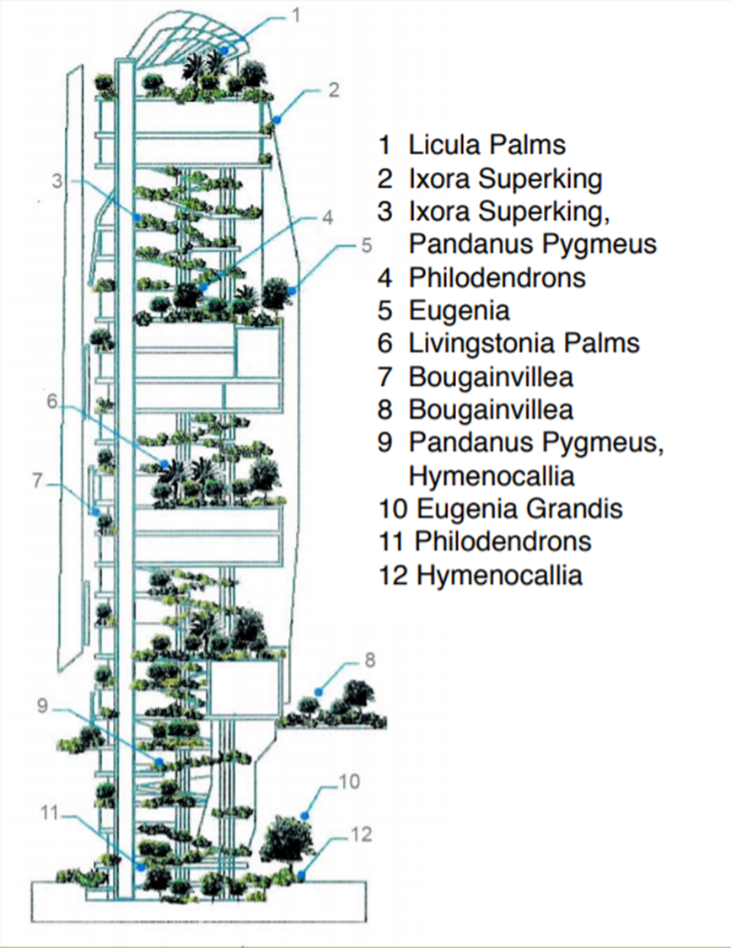
Figure 2: Vegetation species used in Editt Tower
I think the most riveting characteristic of the tower which draws my attention most is it’s ‘loose-fit’ arrangement to change the uses in time. The building also has a really long life-span. The estimated life-span is around 150 years. Some architectural elements of the building are adaptable. Adaptable elements are removable partitions and floors, mechanical jointing that turn the building into a flexible design. By this way sustainability of the building reaches 150 years.
The building also includes a system that reduces water consumption. Average annual water self-sufficiency is 55.1%., they collect water and filter it through the water purification system so both the water and sewage are recycled. Curvilinear roof top rain collector and the attendant rain water façade collector constitutes the water recycling system. (Figure 3)

Figure3: Rainwater collection and filtration system
Also, the building has an air conditioning system which optimizes the mechanical ventilation. It includes passive mode, background (mixed) mode and specialized mode of ventilation. Inn mixed mode the ventilation is optimized according to bioclimatic responses. (Ivor Richards, 2007)
Another natural resource sustaining system is electrical energy. With the photovoltaic panels on façades which faces to east and west side and on roof, produces self-sufficient renewable electrical energy. By these systems which embedded into the design of the tower provides a reduced energy consumption. Photovoltaic renewable electrical energy self-sufficiency is 39.7%. Frankly this system uses solar energy for income and generates electrical energy as outcome.
To conclude, Editt Tower has quite strong claims in sustainability. The methods that applied to this tower are not the most unique ideas which brought to sustainability field but these applications act as a whole with the building and fill the deficiencies in the issues of high rises. Most importantly, these methods area applied without pushing the spatial quality to the background. The tower also has a strong relationship with its natural environment. But because it is an unbuilt project, it is hard to estimate how is the finished version is going to be like. Because the outcome might be different from the expected one. According to my assessment, because Ken Yeang is a master of sustainable architecture and he reinvent the skyscraper typology, I am sure that the tower is going to protect it’s claim on sustainability. In real life things do not match up with the design on the computer screen because there are different parameters ongoing in life and things may derive in a different approach. Life is full of surprises and you cannot conjecture and control every aspect of it.
BIBLIOGRAPHY
· Oven & Dowey (February 2008), Fields of sustainable architecture
· Martin Parker ( Nov 2013),Culture and Organization
· Richards & Yeang (2007), Eco Skyscrapers I
· Powell & Yeang (2007), Designing the Eco skyscraper: Premises for tall building design
· Ken Yeang (2008), Designing the Eco skyscrapers and Eco mimesis
· Lindsay Johnston (2006), Scraping the Green Sky
· Montira Rungjirajittranon(2017), Singapore is the country with the highest urban population in Southeast Asia, UNESCO reported
· Justin Onorati (2009), A greener vertical habitat: Creating a naturally
cohesive sense of community in a vertical multifamily housing structure
· Petar Veselinovic (July,2018), The Impact of Architecture on the Environment
VIDEO REFERENCES
· https://www.youtube.com/watch?v=3q2QtrtM1tY


Comments